Thursday, February 19, 2009

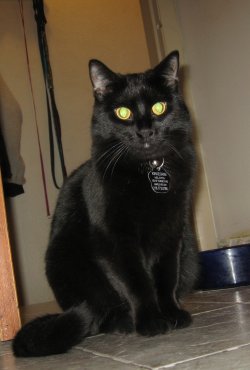
Pet Profiles: Kirkegrim

In Norse mythology, the Kirkegrim guards churches and cemeteries against evil spirits. Commonly in the form of a black dog or a dark, child-sized man, our Kirkegrim takes the form of a little, wide-eyed black cat. He was a feral kitten, tricked and trapped out of his life in the parking lot and transported into a strange new world of people and other cats and a few dogs. He's lived in our house for about a year now and slowly, ever so slowly, is making himself at home.

He can frequently be found lurking at the top of the basement stairs or in the doorway of the spare bedroom. Both locations allow him quick and easy escape routes to safe places where nobody can get him. Before the base strips were in, he could often be spotted crawling out from under the kitchen cabinets, especially around meal times. He is uncomfortable under scrutiny and will tense to run any time anyone makes eye contact with him. Moving within five feet of him will usually send him scurrying. He will leap and scamper off at any noise in general.

And yet, he always seems to be nearby -- just at the edge of the family activity. When we are in the bedroom and all the dogs and cats and people are settled in to sleep, he's a dark shadow in the hallway, peeking. The other day, while we were watching a movie, he snuck up on the cat tree in the middle of the living room and snuggled up with one of the other cats. My husband noticed him and said, "Is that Grim?." When he noticed us looking at him, he quietly slipped down and away, into another room. When we are in the kitchen, he sits in the doorway at the top of the basement stairs, watching. If you move slowly, sometimes you can pet him then. At breakfast time he is in his usual spot, in the bedroom doorway, waiting for the food to come. While the dogs are distracted with their meal, he quietly, quickly makes his way across the kitchen and hops up to eat with the other cats. This is when he is most vulnerable to scritches and snuggles and, when needed, capture. He has a feral cat's appreciation for a free buffet and his tunnel vision for food makes him easy to lay hands on.

But Grim's true kryptonite is the butt scritch. As suspicious and flighty as he is, Kirkegrim cannot control his elevator butt. Touching him anywhere on his back will generally send his front half downward and his rear end up. A few scratches or strokes and he falls right over, begging for a belly rub. He purrs and squirms with wild abandon as his feral, frightened brain takes a break and his happy-snuggly-kitty side comes roaring to the forefront. Basically, he's a sucker for snuggles. If you can get close enough to touch him and there are no big, noisy, scary distractions, he just melts like butter. It takes a bit of patience and good timing to win those precious moments with him but, boy, are they worth the effort. It's a wonderful feeling, to touch another being, and to watch their anxiety transform into pure joy.

Wednesday, February 18, 2009

On Purpose

Setting goals has never been my forte. I'm good at foregone conclusions and great at rash decisions. But goals? Those are structured, planned, budgeted, executed. We -- free spirits, intuitives, emotional beings -- no, we don't have goals. We make plans, we have ideas and dreams, but that's not the same thing. We get stuff done, sometimes big, amazing things, but we're driven by this moment, always, never by the future. At least, not after a certain amount of life has happened -- because eventually you figure out (no matter how sheltered you've been) that the future doesn't do what you tell it to and being too specific is just a really good way of finding that out the hard way. And, shockingly enough, sometimes we just change our minds. Who knew that could happen?

So the trick is to keep the future loose. But, as the song says, "don't let go." You can't build anything if you don't start somewhere and just start laying down your bricks. And even when you realize, somewhere on down the road, that the somewhere you started to build isn't really in the ideal location, or is made from the wrong kind of bricks, well, at least you've practiced building, haven't you? At least you've narrowed in a little bit on what it is your heart most wants to create. And not to get too sentimental or new-agey, but the path of fulfillment is a winding road peppered with signs hammered in place by our heart. Hopefully our brain is helping a bit with placement, because we all know that our emotional centers are fickle and subject to time and the tides and will lead us in circles or into danger and confusion if we are not watchful, but in the end, fulfillment is whatever the heart says it is. It cannot be defined by anyone else or by any standards that do not come from within us. And it's communicated to us in a language of chemical signals and well... feelings.

Unlike animals, who must and do obey their emotional centers at all times, human beings have the ability to do something sometimes called "rationalization." While our heart speaks to us of past experience and the sum of all the information we've absorbed -- our intuition, our emotions, chemicals, and hormones, and physical "pangs" -- our rational mind makes all the final decisions (with the exception of reflexive actions) and plots and points out our future. Basically our human intellect can suggest future directions for that meandering path of the heart to make its way toward. Our rational powers can even push our heart off in directions it doesn't want to go, though that often leads to emotional disaster.

We can also train our heart to feel differently over time. That's called "conditioning" and if it happens on purpose, with purpose, it can be a powerful tool for personal growth. Conditioning is, essentially, teaching physical processes to react in a certain way to stimulus. We condition our muscles when we exercise; we condition our dogs when we train them; we condition ourselves when we stop or start any kind of habit. Conditioning is the way that our rational mind speaks to the "natural" world. And it's our rational mind that carries the responsibility of trying to sort out and interpret those wacky, heart-shaped sign-posts all around us. The rational and intuitive parts of ourselves are, when balanced, equal partners in shaping our day-to-day experiences and the overall shape of our lives. But although they communicate freely and constantly, and they are both essentially us, they don't speak the same language.

And so it can be daunting, to determine how to proceed without having a goal or with having future plans that no longer quite seem to suit, when neither heart nor mind have any overwhelming opinions about where to go next. I have never been interested in opening my sails to the wind and letting them blow me around. And I haven't yet mastered trimming my sails and harnessing the wind to get me exactly where I think I would like to go, so setting off in any direction is risky at best. But change is in the air. Is it simply the restless border between winter and spring? Or does my heart signal a crossroads? And if so, where does it lead?

Tuesday, February 3, 2009

A Bulldog in the Basement

This past Sunday, my husband came home, found me in the living room and said, "Honey, there's a dog in the street. Should we go get him?"

I grabbed a leash and headed out there to see what was going on.

What I found was an SUV stopped in the middle of the street, the couple who owned the SUV standing off the street in someone's driveway, and an American Bulldog begging for a scratch or a scrap. The woman from the SUV told us that he'd just wandered in front of their vehicle and, when they stopped, started sniffing around their tires. They had called the local dog warden already and we let them know that we would take over and let them be on their way.

I put a leash on the dog and my husband went into the house to get him a plateful of dog food. He was not a well-kept animal -- his skeleton was clearly defined, he was not neutered, he had some old scars on his legs as well as other suspicious bald spots, callouses on his hip bones from sitting on hard surfaces, a cloudy infected possibly blind eye, and a tongue that threatened to fall right out of the left side of his face. He smelled like old urine. He ate like a starving hippopotamus. But he was otherwise polite and attentive, good-natured and charming.

We waited out in the cold for a good 20 minutes without any sign of the warden, before we decided to bed him down in a kennel in the basement for the night and decide what to do with him the next day. He was a perfect houseguest, obviously familiar and comfortable with a kennel, quiet, relaxed. Obviously well-socialized at some point, he was simply a really good dog.

The danger in having a really good dog in the house is pretty obvious. At one point I said to him, as he snorted gleefully at me, "It's a good thing you're so ugly, or I'd be in trouble here." Of course, "ugly" is a relative term -- my personal ideal version of canine beauty comes in the shape of a German Shepherd Dog. Compared to that standard, the stocky, overmuscled body, the big round, rock head, the flat faced, snorting, wrinkled, alien-baby face of a bulldog is ugly indeed. For someone who really enjoys taking care of a large number of animals, picking favorite and least favorite breeds is a good way of developing personal boundaries and limitations. No bulldogs! No pugs! No labs! No goldens! No huskies! But it never really matters. The world throws a bulldog in your basement and you can't help but think of how he would fit into the household.

And then discount that option because enough is enough, the inn is full, and this dog is a good dog. And good dogs (especially with alien-baby faces) are easy to place, even with blind eyes and scars and tongues that don't stay inside. I found a nearby vet clinic with an available appointment and off we went for an exam and deworming and the other things a stray needs before they're allowed to fraternize with the rest of the household. I was thinking of options for him -- who do I know that is in the market for a new dog with an alien-baby face? As it turned out, the receptionist at the veterinary hospital was.

"He needs a home? Really?" she said. "My husband would love him!"

And so the deal was done. With a promise of good (and probably discounted) vet care and a home with animal people who think snoring, snorting, and drooling are cute, I handed him over to her. Because of my long history with structured, responsible animal rescue and adoption procedures, I have to say I felt a bit irresponsible handing him over like that. I did not conduct a proper background check. I didn't hold him for 72 hours and run an ad in the paper to give someone the chance to claim him as their lost, beloved pet. I didn't even ask if she intended to have him neutered, let alone ask her to sign a contract promising to give him even a basic level of care.

Basically, I just assumed that this veterinary receptionist, a perfect stranger to me, was agreeing, without us even discussing it, to take over all of the responsibilities that I had not taken care of. It's not like me to make those kinds of assumptions or to be so trusting! But it felt good and right and so easy to say, "He's all yours. Congratulations!" More than that, I felt like I was being let off the hook. I escaped an awful, embarrassing fate -- to tell the world that I, the one who teases, mercilessly, the flat-nose-breed fan club members about their poorly put-together, inelegant, snuffling, snarfling, silly, bossy, bug-eyed, wrinkly "not real dogs," that I had fallen in love with one.